
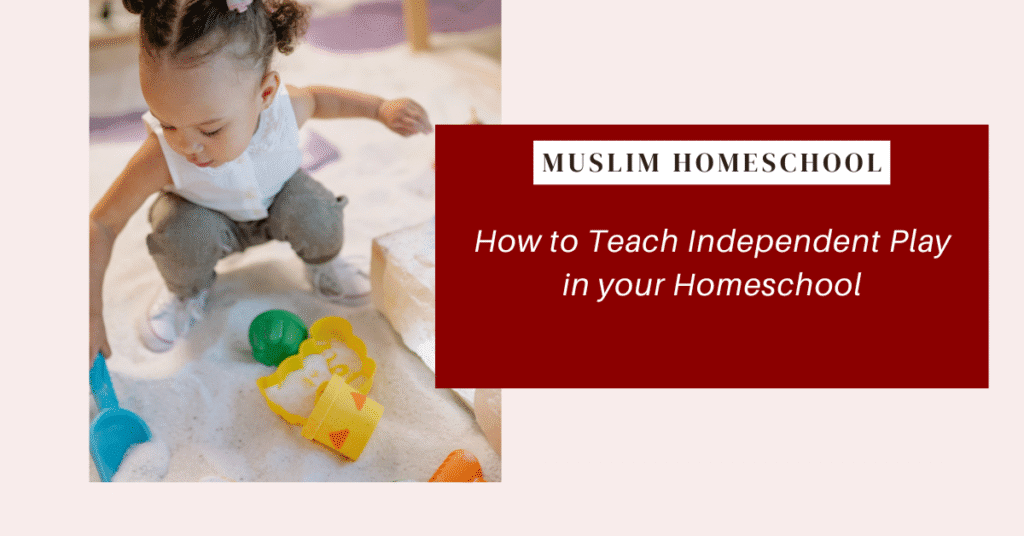
Creating a calm, productive homeschool routine starts with one simple skill: independent play. If you are wondering how to create homeschool routine that actually gives you pockets of uninterrupted time, teaching your young child to play alone is one of the highest return investments you can make. Watch Youtube Video here.
Why independent play changes your homeschool routine
Independent play helps children build imagination, problem solving, and emotional regulation. For you, it creates space to prepare snacks, lead focused lessons with another sibling, tidy up, or simply breathe. Start early when possible. Three to five year olds usually learn faster, though older kids can master this habit with consistent coaching.
Five practical steps to teach independent play
These are the five steps I used and refined until my children were happily playing for 30 to 45 minutes or more. The key is consistency. Use each step little by little and repeat them every day.
- Play first, then set a clear boundary with a timer. Begin playtime by joining your child on the floor. Show interest, give a short demonstration, then say something simple like, “Mama will play with you now, then it will be your turn for five minutes.” Set a visible timer for 5 minutes. After two days at five minutes, increase to 10, then 15, and so on. Starting with shared play builds trust and teaches the rhythm of together-then-alone.
- Have a set daily play time. Make play a predictable part of the day. When children know playtime comes at the same time every day, they relax and learn to prepare mentally to play on their own. A consistent slot in your schedule supports how to create homeschool routine because everyone knows what to expect.
- Resist giving directions during play. Once the timer starts and you step away, keep your mouth closed. Lay out toys and let your child figure out the how and why. Questions, corrections, or suggestions pull kids out of their flow and teach them to rely on you for ideas. Your job at this stage is to provide the environment, not the script.
- Choose open-ended, quiet toys over loud battery toys. Open-ended toys invite creativity and longer engagement. Think train tracks, magnet tiles, dolls, blocks, and animal figures. These items do not prescribe an end point, so children invent stories and build depth. Loud toys with batteries often have a start and stop, which shortens attention spans. Reducing those toys supports a smoother homeschool rhythm.
- Limit the number of toys and rotate regularly. Too many options overwhelm a child. Keep a small selection out and store the rest. Rotate toys every two weeks so old favorites feel new again. This simple change increases interest and keeps independent play fresh, which makes it easier to sustain a consistent homeschool routine.
Practical tips and sample script
Here are quick, ready-to-use lines and small habits that make the steps work:
- Sample script: “We will play together for five minutes. Then your timer will go, and it will be your turn to play alone.” Keep it short and positive.
- Timer tools: Use a visual kitchen timer or an app with a gentle chime so children can see the time and learn independence.
- Rotation schedule: Put most toys in storage and swap every two weeks. Label boxes if helpful.
- Start small: If a child struggles, keep sessions at just a few minutes and praise the attempt. Gradually increase the time.
How this supports how to create homeschool routine
Independent play becomes a predictable pocket in your day. When children can entertain themselves reliably, you can plan focused lessons, manage household tasks, and carve out self-care without constant interruption. Those consistent pockets are the backbone of a calm homeschool routine.